Financial advisors, like lawyers, are regulated in the UK. All financial advisors should be registered with the Financial Conduct Authority (FCA) and must have certain qualifications and have signed up to a code of ethics. UK financial advisors must also complete professional training every year.
However, like legal advice, good commission-free financial advice can be expensive. Chatbots are free; millions of people are now turning to chatbots to plan their investments or their retirement.
Fintechs are now launching AI tools to help customers refine investment strategies and automate financial planning. In February 2026, an AI company called Altruist Corp launched a tool to help financial advisors personalise their clients’ tax strategies. Immediately after this announcement, shares in wealth manager St James’s Place fell 13%, its rival Quilter 5% and the investment platform AJ Bell fell by 8%. The appearance of AI tools has impacted a number of incumbent companies offering financial advice, as well as price comparison websites like MoneySupermarket.
Here are some of the AI tools which have come out for the investment market.
| Company | Tool Name | Primary Function |
|---|---|---|
| Betterment | Account Recommender | AI-generated logic for account optimization and strategy explanation. |
| Robinhood | Robinhood Cortex | Generative AI assistant for market research and plain-language trading. |
| SoFi | SoFi Coach | Personalized financial strategy and holistic account insights. |
| Apex Fintech | AI Suite (w/ Wavvest) | Automated financial planning and real-time portfolio transitions. |
Despite the new specialised personal finance AI tools appearing on the market, people still prefer to use general purpose chatbots, although that may change going forward. Lloyds Banking Group recently commissioned a study of 5,000 Britons, which concluded that more than half had used AI platforms for financial advice. ChatGPT is the most commonly used platform, followed by Gemini. This may be down to the ease of access, the fact that people are already familiar with ChatGPT for other tasks, and the fact that specialist AI tools may not be free.
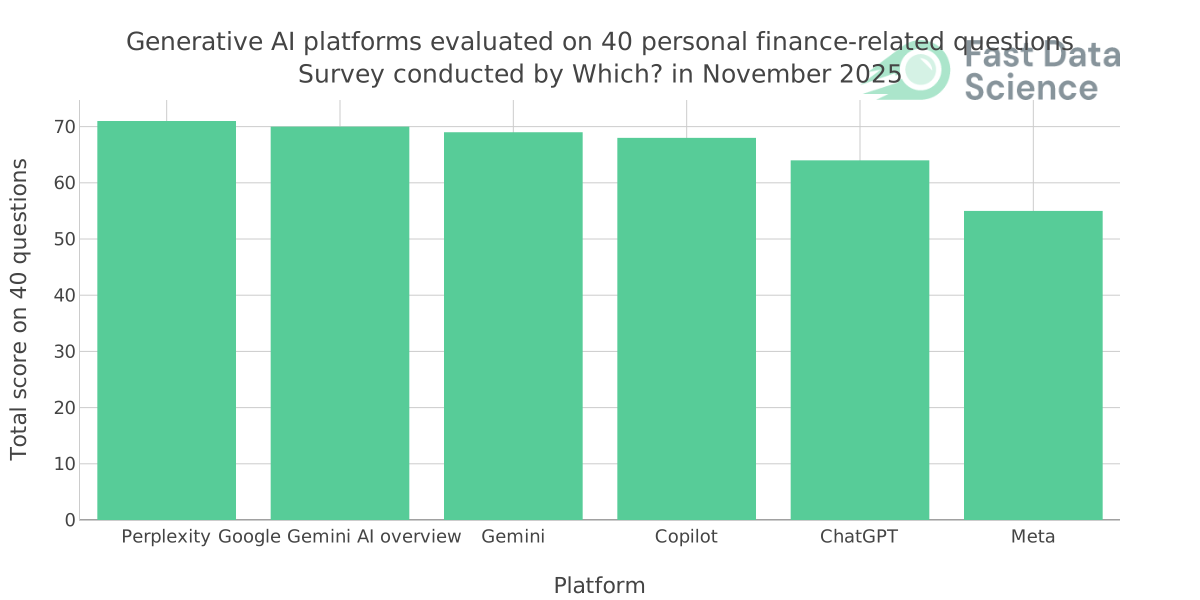
The UK price comparison website Which? conducted an evaluation of the six most popular generative AI platforms, by asking 40 personal finance-related questions and scoring the chatbots on accuracy, relevance, clarity/context, usefulness, and ethical responsibility. Perplexity came out top overall, and the platforms were broadly similar, although Meta scored below the other tools.
The average person in the UK has £16,000 in savings, according to Sky News. The most widely used chatbots in the UK are ChatGPT, Copilot and Gemini, so a team at Sky Money asked the top three AIs what to do with £16,000 to get the best long term return, and asked an investment advisor at Hargreaves Lansdown to evaluate the recommendations.
The adviser found that the investment recommendations were overly concentrated in particular areas, such as US tech. The advisor also noted that many of the recommendations are very US-centric. The UK has very specific rules around taxation, such as ISAs, UK gilts, dividend tax, and income tax, and the US has its own rules, so a chatbot trained on US data is naturally somewhat prone to giving advice that isn’t tailored to the UK. I saw a similar effect when evaluating these chatbots on legal questions, which we were able to mitigate by including snippets of UK statute and case law in prompts.
Without having the exact prompt the Sky researchers used, I cannot reproduce their experiment exactly, but I tried the following prompt:
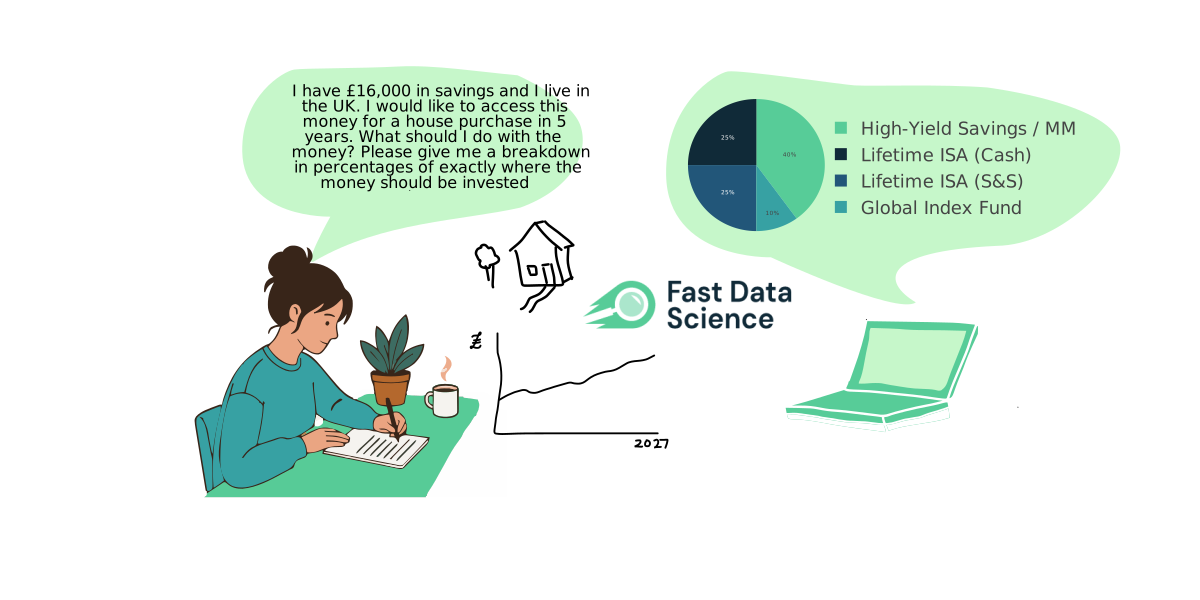
I have £16,000 in savings and I live in the UK. I would like to access this money for a house purchase in 5 years. What should I do with the money? Please give me a breakdown in percentages of exactly where the money should be invested
I got a table back from Gemini with some explanations
| Allocation | Amount | Vehicle / Strategy | Reasoning |
|---|---|---|---|
| 25% | £4,000 | Lifetime ISA (Cash) | Max out this year’s limit to get an immediate £1,000 bonus. |
| 25% | £4,000 | Lifetime ISA (S&S) | Use next year’s limit (starting April) for a Stocks & Shares LISA for growth. |
| 40% | £6,400 | High-Yield Savings / MMF | Keeps the bulk of your deposit safe and accessible. |
| 10% | £1,600 | Global Index Fund | A small “booster” in a standard ISA for higher potential returns. |
What was notable was that it didn’t ask further questions about employment, income, whether I am a first time buyer, my age, other assets, or pensions. For example, a quick Google search brought me to this Government website which says that you have to be between the ages of 18 and 40 to qualify for a Lifetime ISA (a tax free wrapper offered in the UK, corresponding roughly to the Roth IRA in the USA). So without being a financial advisor, I can already see the holes in the recommendations.
Going outside the generative AI related hype, “robo advisers” have been around in the UK for over a decade. The largest is Nutmeg, which manages assets over £7.4 billion but has yet to turn a profit.[1]
Pension providers and other financial institutions are now moving to release their own generative AI tools. So we can look forward to chatbots which, unlike Gemini or ChatGPT, might have access to our bank balance and credit rating.
Overall, I find generative AI very useful for financial education. But, as with legal advice, I would double check any recommendations before acting on them.
Looking for experts in Natural Language Processing? Post your job openings with us and find your ideal candidate today!
Post a Job
Unlock your business potential with expert AI consulting services from Fast Data Science. Discover strategies to accelerate growth and outperform competitors.
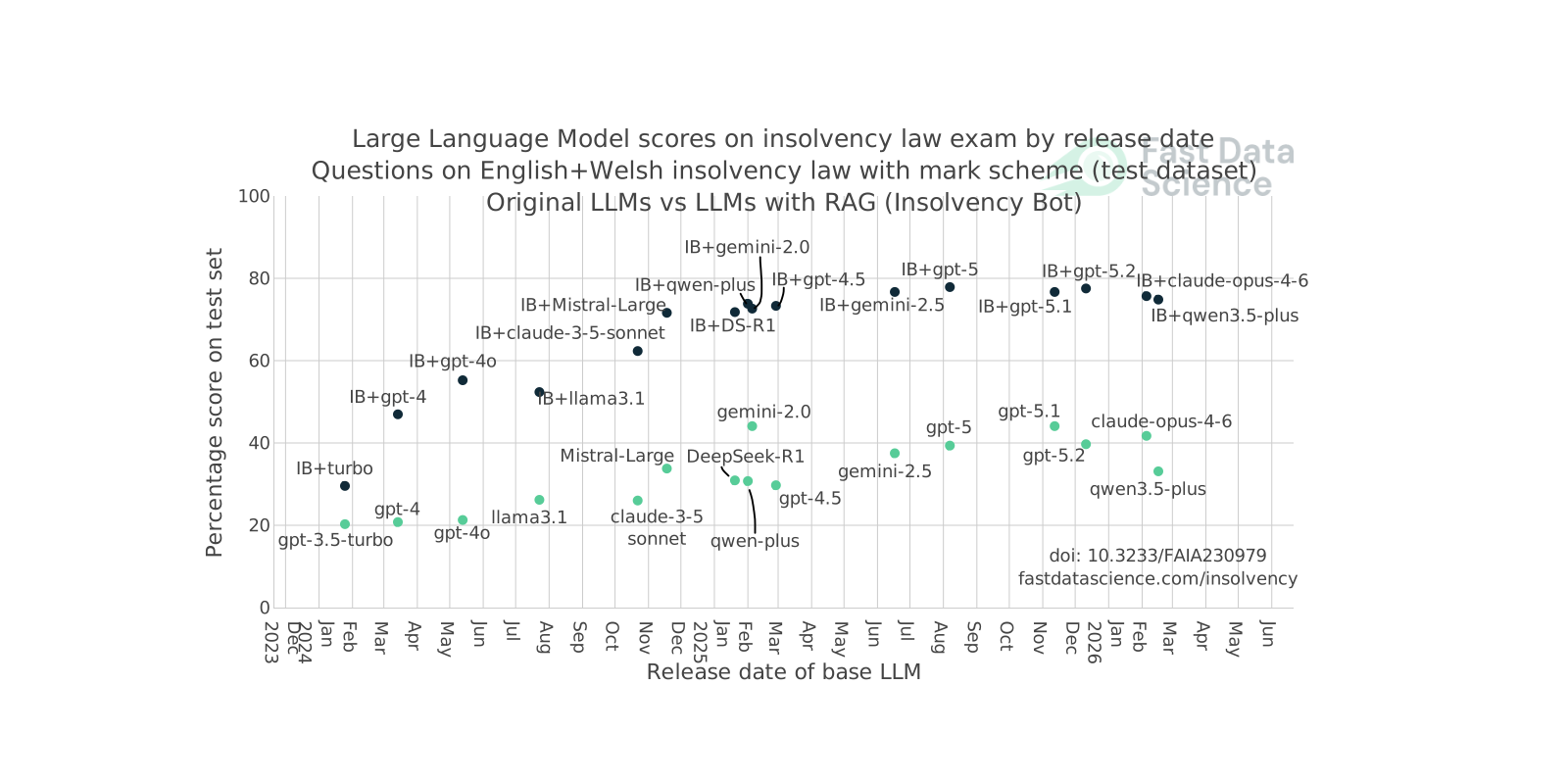
Which is the best AI for legal questions in 2026? We tested 16 Large Language Models (AIs) from the last two years on a law exam.

The effects of AI companies training on creative works When AI companies train models on text, video and images from creative industries, the end product is an AI model which can create near-human quality visual designs or copywriting. Many artists have argued the AI companies are exploiting creatives by profiting from their work, while the original creators do not receive any compensation. By flooding the market with low-cost content, AI has driven down rates for human artists, which is threatening creative careers.
What we can do for you