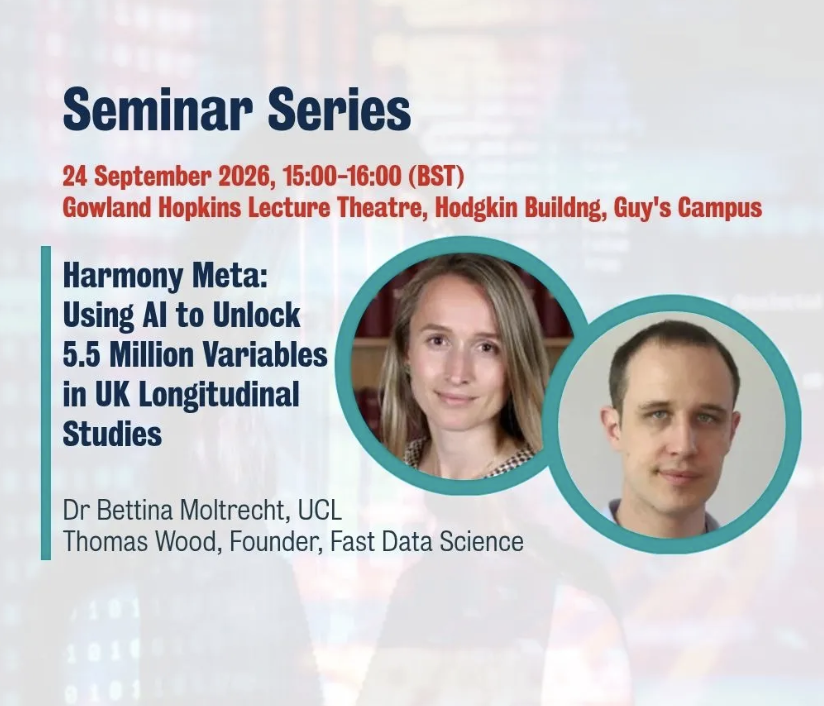
The Harmony project is an Official Partner of AI UK 2025, the UK’s national showcase of data science and artificial intelligence, hosted by The Alan Turing Institute.
Bettina Moltrecht and Thomas Wood will be presenting Harmony at the AI UK event and we will also have a stall.
Join the workshop – Monday 17 March, 10 AM - 12 PM – where we’ll dive deep into how Harmony is being used to improve research data with Bettina Moltrecht and Thomas Wood.
Harmony is a new open-source data tool, a winner of the Wellcome Trust Mental Health Data Prize, which uses custom LLMs to help researchers compare and harmonise metadata from different research studies.
Join this 2 hour workshop for a deep dive into the Harmony project, get insights into the tool, how to use it and how it can transform your research and data science processes. We will also introduce to the next phase of Harmony where we will apply it to data discovery challenges. There will be live demos of the tool and live discussion around use cases and applications. We will also share our coding and design challenges and how you can get involved in in the Harmony community.
Workshop booking will open for all in person delegates at 10am on the 12th March
We’re excited to offer a 15% discount on AI UK 2025 tickets for our community! A limited number of discounted tickets are available, and we’re offering them to our colleagues and partners first.
👉 Register here: https://ai-uk.turing.ac.uk/register/ and use the code HARMONY15OFF at checkout to claim your discount.
Looking for experts in Natural Language Processing? Post your job openings with us and find your ideal candidate today!
Post a Job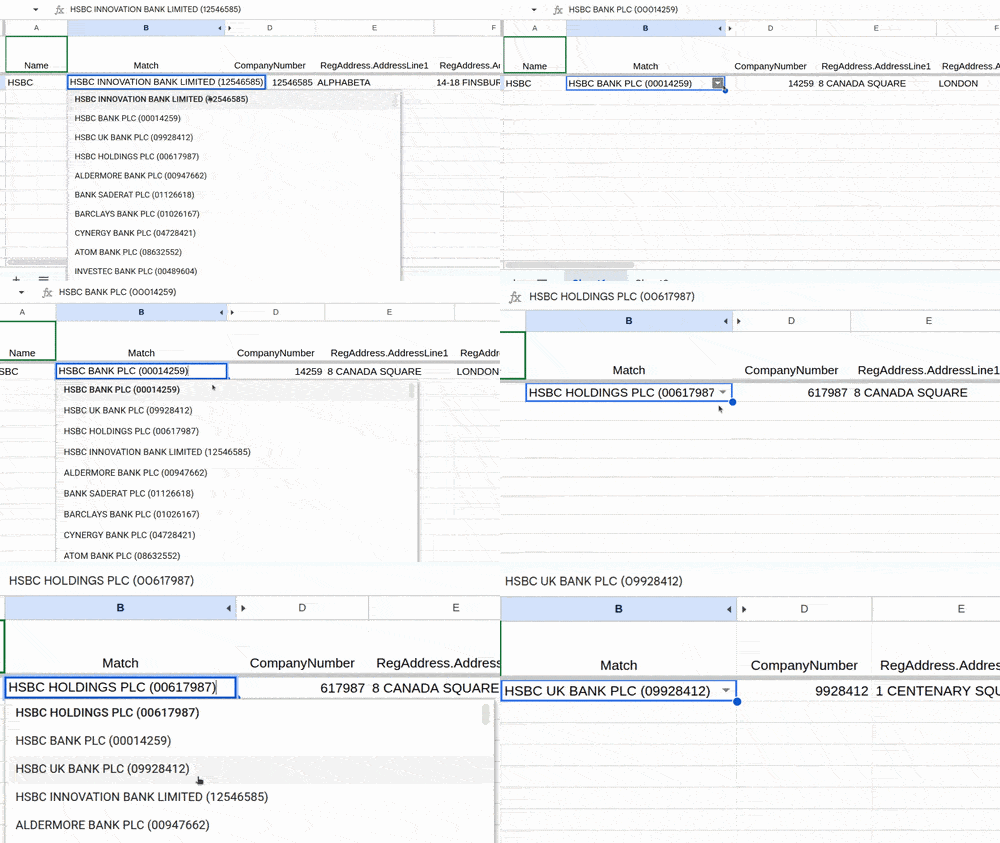
} Fast Data Science are pleased to announce we have updated the UK Company Details Google Sheets™ plugin. The plugin allows you to retrieve details such as company number, incorporation date, address, and directors’ details from Companies House (the UK company registry) and automatically populate them in columns of a Google Sheets™ spreadsheet.
We are all familiar with the general-purpose chatbots like Gemini, GPT, and Claude. Companies and organisations have also been creating internal and external facing special-purpose chatbots, such as those which can book flights, tell you the weather, answer healthcare related queries, or answer questions about government procedures.
What we can do for you