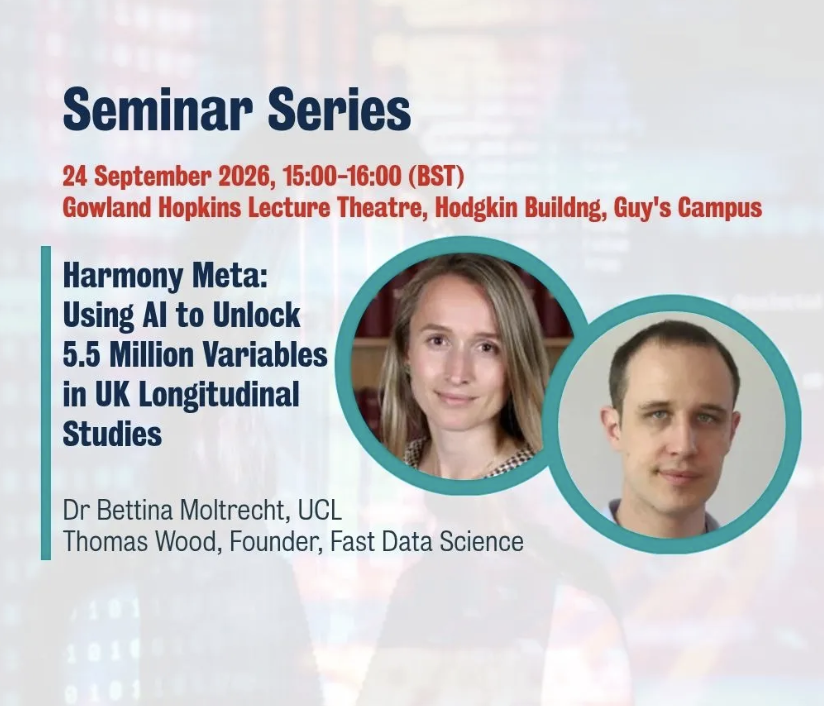
Thomas Wood, director of Fast Data Science, and Dr Bettina Moltrecht of UCL appeared at DRIVE-Health, an event hosted at Kings College London, to present Harmony Meta on 24 September 2026.
Harmony Meta is a tool developed to bridge the gap between disparate study catalogues and registers. While traditional data discovery relies on exact keyword matching, Harmony Meta uses Large Language Models and vector indexing to allow for semantic searching across 5.5 million variables.
Abstract: This session demonstrates how researchers can now locate longitudinal data using approximate synonyms—for instance, a search for “dyslexia” will successfully retrieve variables related to “difficulty reading.” The platform indexes nearly every major longitudinal study ever conducted in the UK, including the Millennium Cohort Study, the 1970 British Cohort Study, and Born in Bradford. The presenters discuss the technical backend of converting millions of variables into vectors and the practical implications for harmonizing data across different cohorts to identify population mental health trends.
Try the tool: https://harmonydata.ac.uk/search
DRIVE-Health
Note on Funding and Partners: Harmony Meta was funded by the ESRC and developed in collaboration with Population Research UK (PRUK), the UCL Centre for Longitudinal Studies, DATAMIND UK, The Alan Turing Institute, and UK Research and Innovation.
Ready to take the next step in your NLP journey? Connect with top employers seeking talent in natural language processing. Discover your dream job!
Find Your Dream Job
We are all familiar with the general-purpose chatbots like Gemini, GPT, and Claude. Companies and organisations have also been creating internal and external facing special-purpose chatbots, such as those which can book flights, tell you the weather, answer healthcare related queries, or answer questions about government procedures.
What we can do for you