We are pleased to announce the publication of our paper A generative AI-based legal advice tool for small businesses in distress, in collaboration with an interdisciplinary team based in the UK and Hungary.
This paper describes the development and evaluation of the Insolvency Bot, a legal chatbot designed to provide reliable advice on corporate insolvency in England and Wales for small business owners.
We used Retrieval Augmented Generation (RAG) to enhance large language models with a curated knowledge base of 6,000 legal texts, including statutes, HMRC forms, and case law.
Thomas Wood, the director of Fast Data Science, was responsible for building the system in Python and implementing the machine learning models and vector embeddings that allow the bot to retrieve relevant legal information. Fast Data Science hosts the live version of the tool on our website at https://fastdatascience.com/insolvency
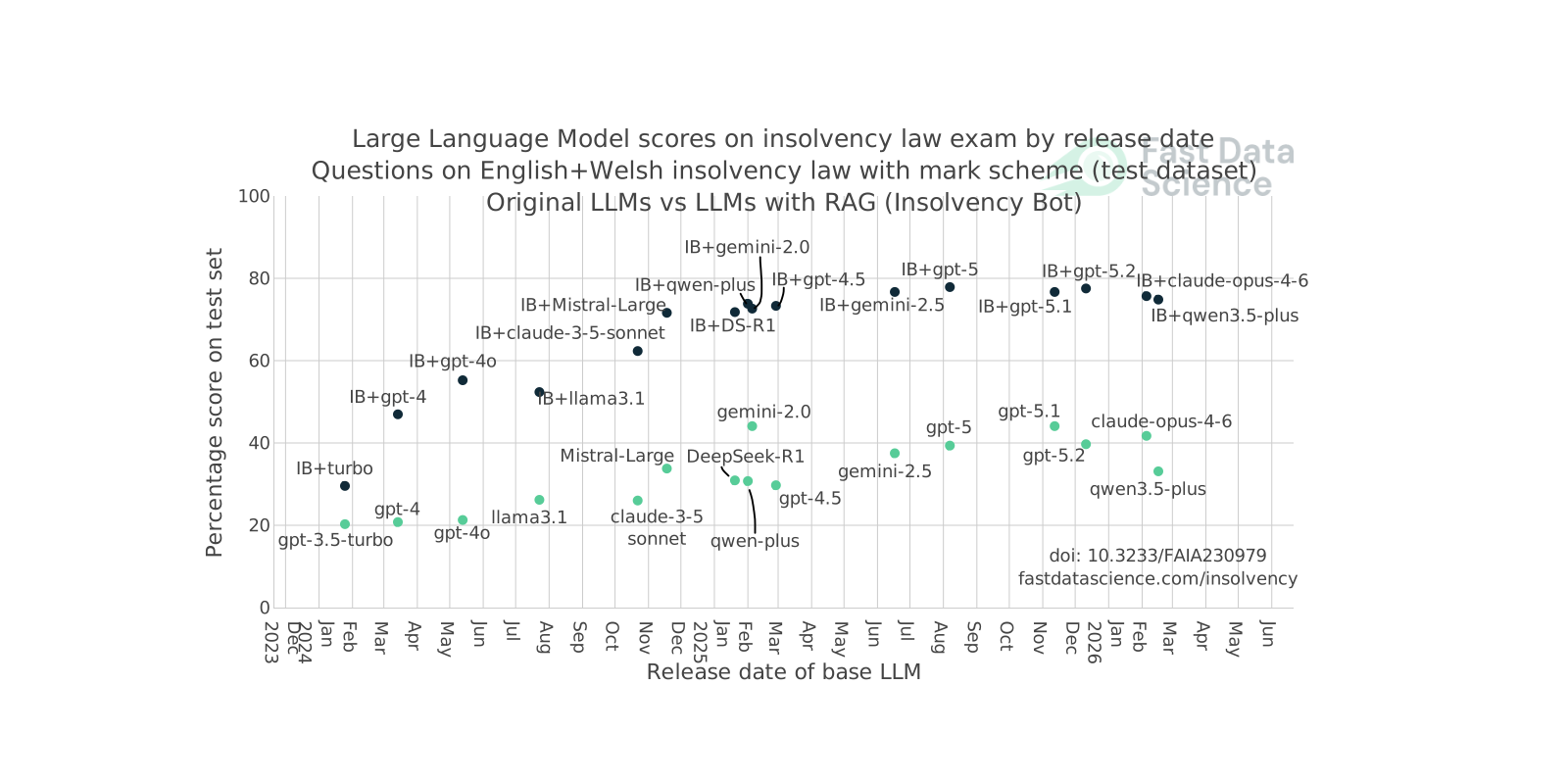
We developed and tested the performance of a retrieval augmented generation (RAG) system for answering legal queries related to corporate insolvency in England and Wales. The Insolvency Bot relies on open-source legal information and HMRC forms to provide sound responses to a user’s query focusing on insolvency matters regulated by English law. We evaluated our bot head-to-head on an unseen test set against the unmodified versions of large language models (LLMs) gpt-3.5-turbo, gpt-4, or gpt-4o with a mark scheme similar to those used in examinations in law schools. The Insolvency Bot outperformed each unmodified LLM (p = 0.05%). An additional user experience survey suggested the need for creating two versions of the bot, one for lay people who expect practical and actionable advice and another for professionals with the relevant legal authorities. Our legal chatbot demonstrates the benefits of combining a generative AI system with a trusted knowledge base and shows future promise to cover cross-jurisdictional and insolvency-related queries and could be further improved in its technical architecture.
More information: https://pure.royalholloway.ac.uk/en/publications/a-generative-ai-based-legal-advice-tool-for-small-businesses-in-d/
Dive into the world of Natural Language Processing! Explore cutting-edge NLP roles that match your skills and passions.
Explore NLP Jobs
Unlock your business potential with expert AI consulting services from Fast Data Science. Discover strategies to accelerate growth and outperform competitors.
Financial advisors, like lawyers, are regulated in the UK. All financial advisors should be registered with the Financial Conduct Authority (FCA) and must have certain qualifications and have signed up to a code of ethics. UK financial advisors must also complete professional training every year.
What we can do for you