The global economy is in an AI boom. Expert opinions are divided over whether this boom also constitutes a bubble, although there are warning signs. In a recent article by four members of the faculty at INSEAD Business school, the general consensus was that we’re not yet in a bubble, as earnings growth has generally corresponded to stock prices, but the market is pricing in expected growth in the future. However, there is a risk that future earnings won’t match these expectations, and we should be concerned about circular financing in AI deals, where there is a complicated web of dependencies between companies like Microsoft and OpenAI.
Key metrics like the Shiller P/E ratio point to AI stocks being overvalued at a level comparable to the dot-com boom. But there are many differences between the current boom and the dot-com era. Back in 1999, the boom was driven by newly-listed loss-making stocks, but nowadays the “bubble” is propelled by established companies like Microsoft, Nvidia, and Google.
We should probably expect several sudden corrections in the valuations of many of the companies propelling the AI boom, as companies fail to deliver the productivity that was promised. However, I personally do not expect to see a crash similar to the dot-com crash of 2000. However, incumbents may be unseated, and well-placed newcomers are likely to benefit and become hugely profitable. We have already seen established software businesses like Salesforce take a hit to their share price when new AI models are released, as investors anticipate that new AI models will chip away at their competitive edge.
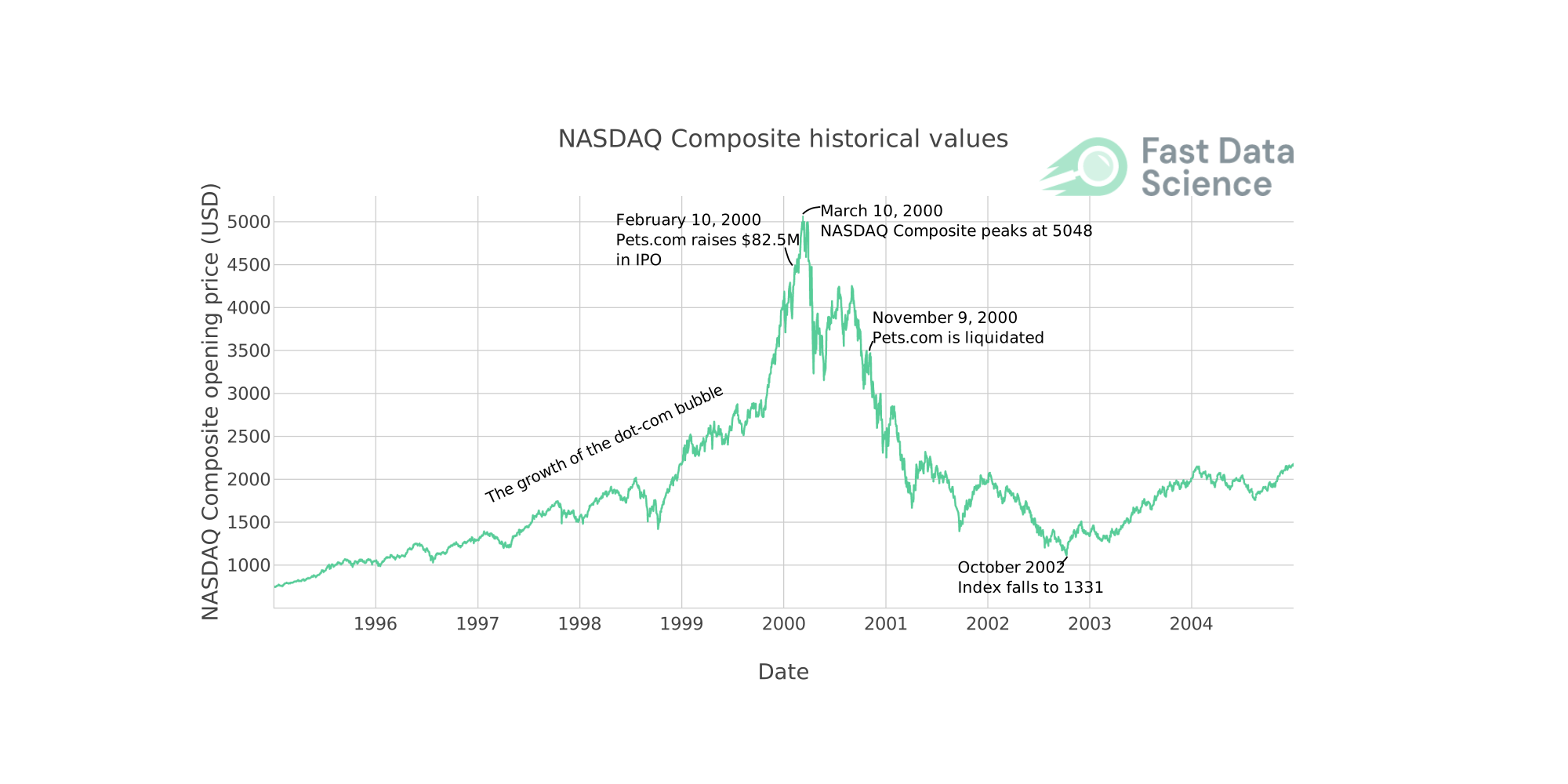
The late 1990s are notable for the rapid growth of the dot-com bubble, following the invention and rapid adoption of the internet. The bubble didn’t survive long into the new millennium. On March 10, 2000, the NASDAQ Composite Index peaked at 5048, but by October 2002, it had fallen back down to 1331. You can see the meteoric rise and dramatic fall of the index in the graph above. Recovery took years. If you had put all your savings into a NASDAQ-linked index fund at its peak in 2000, you would not have broken even (allowing for inflation) until 2017, seventeen years after the crash!
One of the many casualties of the dot-com boom was the online pet shop Pets.com.[7] In 1994, the Pasadena-based entrepreneur Greg McLemore bought the pets.com domain name and launched a website in 1998, aiming to sell pet supplies such as dog food on the internet, competing with traditional brick-and-mortar pet shops. The company raised $50 million in a Series C funding round, with Amazon being one of the principal investors. But by November 2000, less than a year after raising huge sums of money from its backers, the company had failed and was shut down.
The record valuations of technology and AI stocks in 2026 has prompted many to draw comparisons to infamous stock market bubbles of the past, such as the dot-com bubble, the railway mania of 1845, the Wall Street crash, and even the Dutch “Tulip Mania” of 1634-1637.
| Bubble | Year | What happened? |
|---|---|---|
| Tulip Mania | 1634-1637 | Tulip bulbs in the Netherlands sold for more than the cost of a house before crashing. |
| Railway Mania | 1840-1847 | Prices of railway shares increased, encouraging speculators to invest more money, further increasing prices of railway shares, until the shares collapsed. Fraudulent financiers such as George Hudson contributed to the bubble by paying dividends with the money raised from speculators. |
| Dot-com bubble | 2000 | Investors poured money into any company with a “.com” suffix, regardless of profitability. |
| US housing bubble | 2008 | Cheap credit and subprime mortgages led to a housing peak that nearly collapsed the global financial system. |
| AI bubble? | 2022-? | Theorised stock market bubble starting with the launch of ChatGPT and competitors. |
A stock market bubble is when share prices climb to a point, driven by speculation, where they far exceed their value. Rising prices lead investors to believe that prices will keep climbing, and people buy more stocks through fear of missing out. This behaviour has been called “irrational exuberance” (more about that in a minute). Eventually a bubble will burst and prices drop, often leading to panic selling and a stock market crash. Before the inevitable crash, it is hard to distinguish a bubble from a regular economic boom.
Robert Shiller, who won the Nobel Prize in Economics for his “empirical analysis of asset prices”, describes a bubble as being similar to a “naturally occurring Ponzi scheme”,[3] whereby investment is driven by excitement as speculators see how others have made money, further driving the feedback loop that pushes prices up. (A real Ponzi scheme is an investment scam in which a fraudster encourages speculators to invest, and pays the early investors using funds received from later investors.) Shiller considers real Ponzi schemes as “controlled experiments” in bubbles conducted by the fraudsters running them.
Although the term “bubble” is used colloquially, there are a number of technical definitions developed by economists. One of the most widely used definitions of an economic bubble is a situation where the market price of an asset (i.e. what you would pay to buy a stock) is greater than the value of the earnings that it is expected to earn in the future.
For example, at the time I’m writing this, you can buy a single share of Alphabet (Google) for $298.14. If we agree that the expected dividends are $100 (after correcting for inflation), and many other companies are overvalued in this way across markets and indices, then this would be a sign that we’re in a bubble.
The problem is that nobody can really say for certain what the future earnings are of a stock. We can agree on the past earnings (dividend payments), but these don’t always correspond to future earnings, especially in the case of emerging technologies.
With the benefit of hindsight, could we have identified the dot-com bubble at the time?
In 1996, the chair of the Federal Reserve Board, Alan Greenspan, warned that the stock market might be overvalued, saying,
…how do we know when irrational exuberance has unduly escalated asset values, which then become subject to unexpected and prolonged contractions as they have in Japan over the past decade?
The speech was televised and caused stock markets around the world to immediately drop. The term “irrational exuberance” became well-known and was later used by Robert Shiller as the title of his book, Irrational Exuberance,[3] where he examines economic bubbles in the 1990s and 2000s.
In 2002, two years after the bubble eventually burst, Greenspan remarked that,
As events evolved, we recognized that, despite our suspicions, it was very difficult to definitively identify a bubble until after the fact–that is, when its bursting confirmed its existence.
In 1999, Warren Buffet famously refused to invest in technology stocks, saying that he didn’t invest in things he didn’t understand.
…This explains, by the way, why we don’t own stocks of tech companies, even though we share the general view that our society will be transformed by their products and services. Our problem – which we can’t solve by studying up – is that we have no insights into which participants in the tech field possess a truly durable competitive advantage.
Buffett was widely criticised in 1999 for his aversion to technology stocks, but he was vindicated after the dot-com bubble burst, and his portfolio benefited from staying out of technology.
We can see that a number of well respected individuals were aware of the existence of a bubble. When we are in a bubble, people often agree on the fact that it exists, but are unable to foresee the exact timing that the bubble will pop.
A common metric used to identify stock market bubbles is the Shiller CAPE Ratio (“Cyclically adjusted price-to-earnings ratio”), which is the price-to-earnings ratio for the last ten years (share price divided by the last ten years’ earnings), adjusted for inflation. It measures how expensive a stock is compared to its earnings, taking into account multiple economic cycles. We usually calculate the Shiller CAPE ratio for the S&P 500 index, which is a basket of 500 US technology companies.
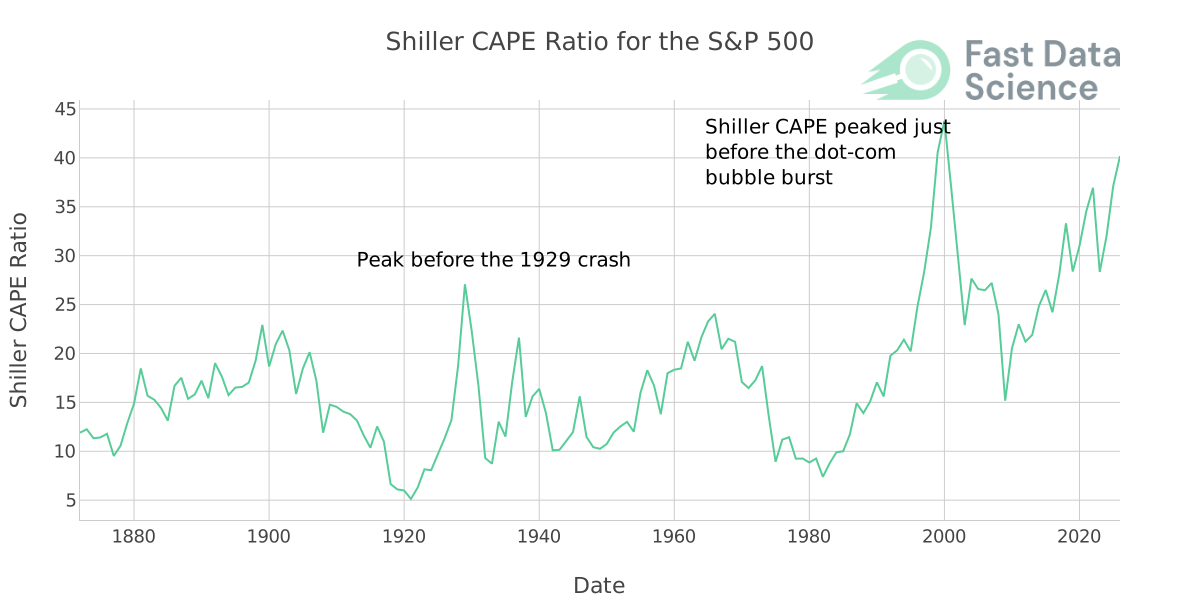
The S&P 500 index is now more expensive compared to earnings than it was just before the 1929 Wall Street Crash, and on the cusp of the 2008 financial crisis. Going back to the 1840s, the only time that we have seen higher Shiller CAPE Ratios was during the dot-com bubble in 1999/2000.
A company may look expensive if you take the current price and divide by the past earnings. But we should remember that many tech companies such as Amazon and Uber have been unprofitable for years before turning a profit. So a company that appears overpriced when looking back at the last ten years’ earnings, may not be overpriced if the expected future earnings are taken into account. The problem is that future earnings are only future projections and people may disagree on what they will be.
The following are key symptoms of bubbles:
There are a number of types of bubbles, from stock market bubbles, to real estate bubbles, commodity bubbles, and credit bubbles.
In April 1996, during the dot-com craze, Fortune reporters tried stopping random people on the street and asking them for stock tips. They didn’t find a shoe-shine boy, but they did speak to a policeman, a barista, a carpenter, and others, and everybody offered stock recommendations! Do you think that would be the case now, in 2026?
In the last few years, we have seen incredible increases in the capability of generative AI. Despite its limitations, AI is already beginning to replace semi-skilled and even some skilled professionals. Many aspects of software engineering can now be automated. I have built a number of software prototypes using generative AI coding tools such as Google Antigravity and Cursor, where previously I would have hired freelancers such as front end developers. I have also used it instead of professional services such as legal advice, intellectual property, and so on (avoiding making any critical decisions based on AI advice of course).
One open question is, who will benefit from this? Recently, the stock markets have seen a phenomenon known as the “AI scare trade”.
In January 2026, Chuck Robbins, CEO of Cisco, said that the AI boom will be bigger than the internet, but there will be “winners and carnage”, and some companies “won’t make it”.[8]
Software businesses such as Salesforce, which sells software services for customer relationship management (CRM), have seen their stock value fall recently because the development of AI coding is perceived as a threat to their moat.
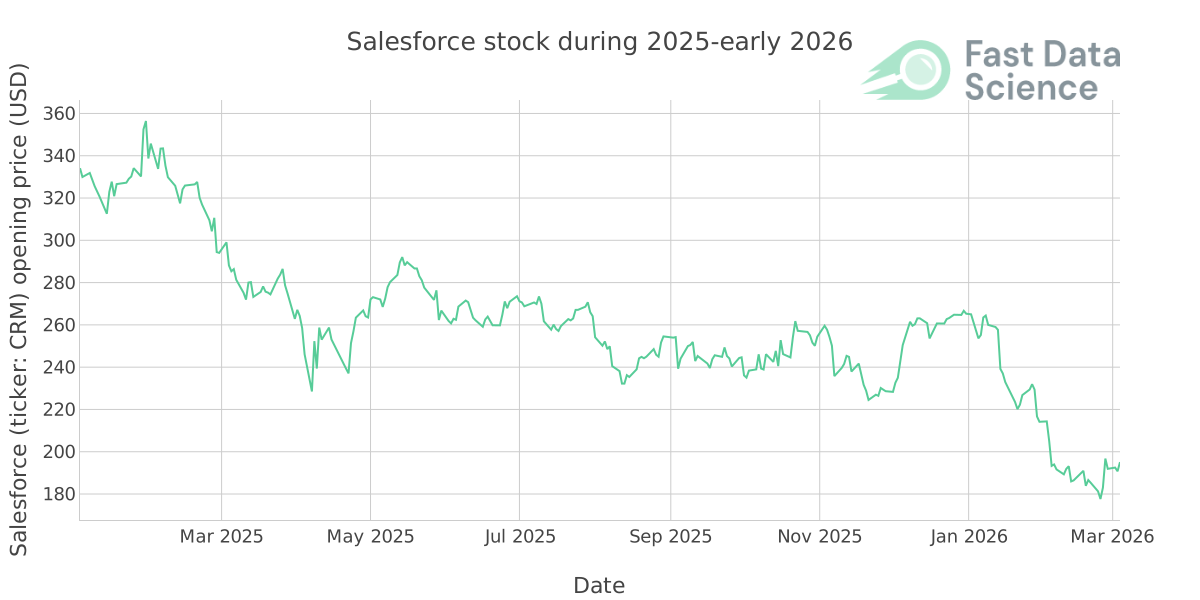
Above: the stock for Salesforce (CRM). Many of the big dips correspond to announcements by AI companies such as Anthropic.
There is a concern that AI will make it so easy to build custom software, that customers will not need to pay so much for CRM platforms any more. Announcements of new iterations of OpenAI, Google, Anthropic and DeepSeek models often result in shocks to tech stocks, as investors become spooked that the latest iteration of generative AI will chip away at software companies’ long-established products and market share.
Recent estimates of the increase in annual productivity due to AI adoption range from 0.1 to 3.4 percentage points, so AI could result in a small boost to productivity or a more than twofold increase in growth, depending on who you talk to[4].
In my opinion, what is most likely is that AI will cause some incumbents to lose market share or even fail entirely, some incumbents will benefit from AI, and many completely new entrants will come to dominate the new landscape.
In 1845, the UK was in the grip of a different stock market bubble: “Railway Mania”. Railway investment reached 6 percent of GDP and hundreds of new lines were being proposed[4]. As the price of railway shares increased, people invested more money into railway companies, further increasing the price of those shares. Even people with modest incomes were pouring their life savings into buying shares in railway companies.
However, about a third of the railways authorised were never built. By 1850, railway stocks had lost between 50% and 85% of their value. George Hudson, a financier who controlled a large part of the railway network in the 1840s, was forced to flee abroad to avoid being arrested for debt.
Despite this, railways did go on to transform the landscape of the country and dominate the stock market. The infrastructure built in the 1840s is still the backbone of the UK’s railway network today, but many of the companies which built the rail network went bust in the 1850s.
Drawing parallels with the present AI boom, it is quite plausible that the companies that are receiving large amounts of investment at present, are not all those which will endure the hype and survive the present bubble. The AI boom may leave us with infrastructure and technology advancements that would not have happened without the boom, but the companies on the cusp of it may not survive the bubble bursting.

Above: George Hudson (1800–1871), the “Railway King”, who controlled a large part of the UK’s railway network in the 1840s. Image is in the public domain. Portrait by George Raphael Ward, displayed in the National Portrait Gallery.
As I mentioned above, Warren Buffet managed to emerge from the dot-com bubble unscathed by avoiding technology stocks. Simon Edelsten, a fund manager at Goshawk Asset Management, writing in the Financial Times, described his “biggest investment mistake” during the 2000 bubble as being an investment in an incumbent, Yellow Pages, which he expected to benefit from the new technology, but turned out to be a loser in the long term.[6]
At the start of the dot-com boom, the Yellow Pages (a trading name of Yell) was a profitable business. Delivered door to door since 1966, it was the go-to way to advertise your business. Edelsten assumed that the company was ideally placed to benefit from the advent of the Internet. Its costs would drop (printing, distribution) and its website would be the place to find traders.
Google, after launching in 1998, eventually grew to dominate the business advertising space, and Yellow Pages underwent a series of restructurings and Edelsten never recovered his initial investment. The new technology did indeed prove to be profitable, but not for Yell. The Yellow Pages is no longer printed as a physical book, but operates as a digital marketing agency.
Edelsten concludes that the best strategy to take advantage of a growing bubble is to diversify and aim for a large number of smaller holdings. However, you can also opt for Warren Buffet’s strategy of identifying “quality” companies,which should have barriers to entry, such as branded goods, railways and energy.
In no circumstances should we assume that an incumbent will remain an incumbent when technologies are changing so rapidly. We should avoid unsubstantiated hype and companies that seem to offer only vacuous promises of future growth.

The Yellow Pages was delivered door to door around the world, but didn’t survive the dot-com boom. Image by Andrew Sullivan (Kabl00ey) - Own work, CC BY-SA 3.0, https://commons.wikimedia.org/w/index.php?curid=2954759
It’s hard to compare like-for-like with the dot-com bubble. But when I tried plotting graphs of how the NASDAQ index behaved just before the collapse of the dot-com bubble, the dot-com bubble was noticeably steeper in terms of growth even when displayed on a logarithmic scale. In the below plot I have (somewhat arbitrarily) plotted the two booms with a 20 year delay.
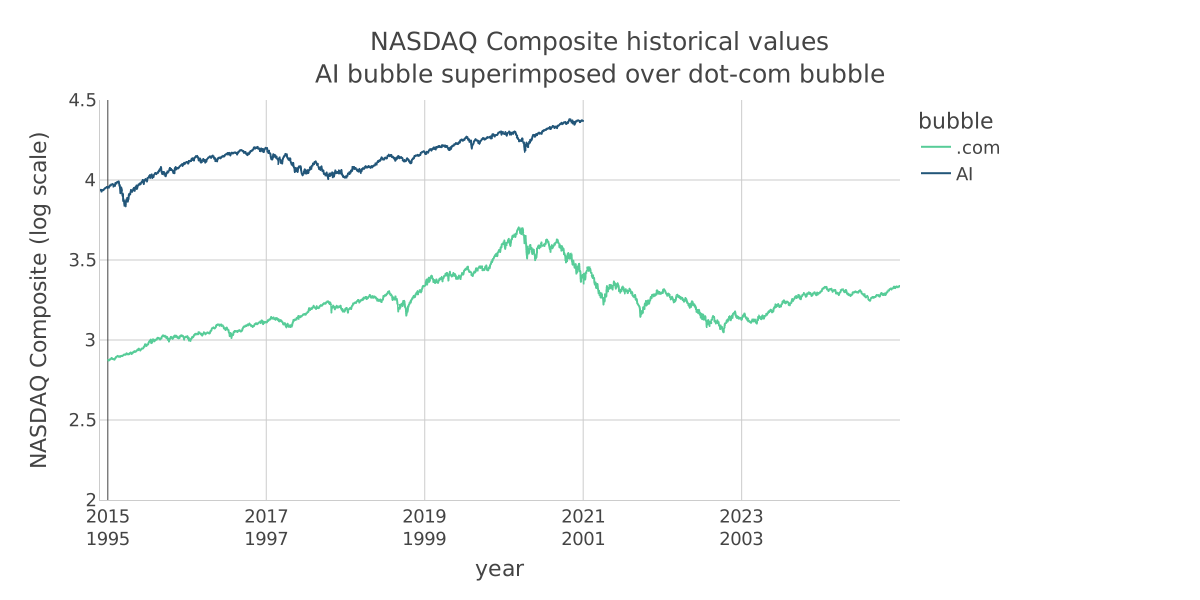
Above: the NASDAQ Composite Index during the dot-com bubble and during the AI boom, superimposed with a 20 year delay on the time axis. In the interactive component below, which uses data from the Yahoo Finance API, you can try adjusting the offset value.
Interactive: Drag the dot-com series left/right to shift the timeline
In early 2026, we have seen a software industry sell-off. Microsoft, Google, Amazon, Meta and Netflix stocks have slumped. Investors have been underwhelmed by the returns on massive AI investment in those companies.
However, AI can now do the job of a junior software engineer, paralegal, or junior clerical worker in nearly any industry. This is a huge advancement that hasn’t yet taken off. The companies that benefit from this may not necessarily be the big tech companies who are pouring money into AI R&D, but perhaps small and medium sized companies which can suddenly save huge amounts on staffing costs.
I have found AI coding only to be viable (as in, its output is actually usable) since the start of 2026, so this technology is really in its infancy, but the productivity gains are enormous. I can open up a tool like Google Antigravity and give a very precise instruction to build a website, API, or mobile app, and it can quite easily turn out something comparable to a junior software developer given the same instructions, for a fraction of the cost.
In February 2026, a tech founder called Matt Shumer wrote a viral blog post titled Something big is happening in AI — and most people will be blindsided, describing how instead of manually writing code, he opens his AI tools and writes a complete detailed description in English of what he wants developed, leaves the AI working for a while, and comes back and tests it.[9]
Below I can show you the example of a prompt that I used to make a web app using Google Antigravity. You can see that my prompts are still not quite what a non-technical user would give: I have to be very specific about file paths, versions, and technology stacks, to get the best results.
Make a React app using Node 24.13.0. It is a game for children to learn times tables.

It has an octopus. The octopus graphics assets are provided in folder `assets`.

It presents each times tables question with an animal, e.g. "how many tentacles do 8 octopuses have"?

There are 11 different octopus GIF animations.

The React game should be a  basic platform game which is set underwater. The octopus must swim to find a treasure chest which has the correct number there. If the question is about 9  octopuses then there should be 9 octopuses on the screen.

When the player has answered 11 questions correctly then they get a screen where they can decorate a trophy and share or save the image.
I have been able to write prompts like this for less than a year, but it’s already making a huge improvement to my productivity, allowing me to develop in languages and frameworks beyond the ones that I’m fluent in. For example, I can easily develop code in Python, the lingua franca of data science, but AI will let me code large Python applications much faster. For frameworks like React, which is used for graphical functionality and front ends, I would previously have needed to outsource work, but I can now do things myself with AI in a fraction of the time, making a huge saving in terms of labour costs.
Outside of software development, adoption has been more muted. AI has been used to generate low quality “slop” such as verbose emails or low-effort social media posts, which don’t save anybody any time.
There is scant evidence of AI-fuelled productivity gains at present when we look at developed economies as a whole. In the USA, real GDP has been growing at an annualised rate of 1.4%, which is lower than you would expect looking back over historical GDP values since 1950. One theory is that improvements in technology start to impact productivity not when workers start using a new tool, but when companies plan their processes around that new technology. For example, the introduction of electricity into factories started to make firms more efficient only once factory floor plans were redesigned around electric power.[10
First of all, this may be a straightforward economic boom rather than a bubble in the sense of the dot-com bubble.
Although AI is now able to perform impressive tasks and replace some expensive professionals such as software developers, companies have not yet reported productivity gains. The stock markets have surged mainly due to investment in AI infrastructure. There is concern around the circular nature of investments that are fuelling the current AI boom: a number of large AI companies have invested in each other, or depend on each other for materials. Several market shocks have come when earnings reports have made it clear to shareholders that the productivity improvements have not yet arrived - perhaps because the equivalent of “redesigning the factory floor” has not yet taken place - and may not take place for a few years.
Since the stock market behaviour is not quite as “exuberant” as during the final years of the dot-com boom, I do not imagine a crash of anything like the magnitude of what happened in March 2000. We can expect some market corrections as things become clearer, and AI becomes integrated into companies’ processes and productivity increases.
None of the content of this article constitutes investment advice.
The best advice at this point is to adapt as much as possible to the new technology. Get used to learning new tools quickly as AI is changing. From the point of view of our own careers, we can future-proof our employability by staying on top of tools and methods, and making a habit of experimenting.
In terms of our own investment portolios, the companies with stock that has shot up in the last few years are not necessarily the companies which will benefit from the AI boom in the long run, so we should diversify our investments as much as possible, remembering Warren Buffet’s maxim that he doesn’t invest in things that he doesn’t understand. Incumbent software-as-a-service companies have already been shown to be vulnerable, as their moat (their software product) evaporates due to the ease of writing new software.
Dive into the world of Natural Language Processing! Explore cutting-edge NLP roles that match your skills and passions.
Explore NLP Jobs
Unlock your business potential with expert AI consulting services from Fast Data Science. Discover strategies to accelerate growth and outperform competitors.
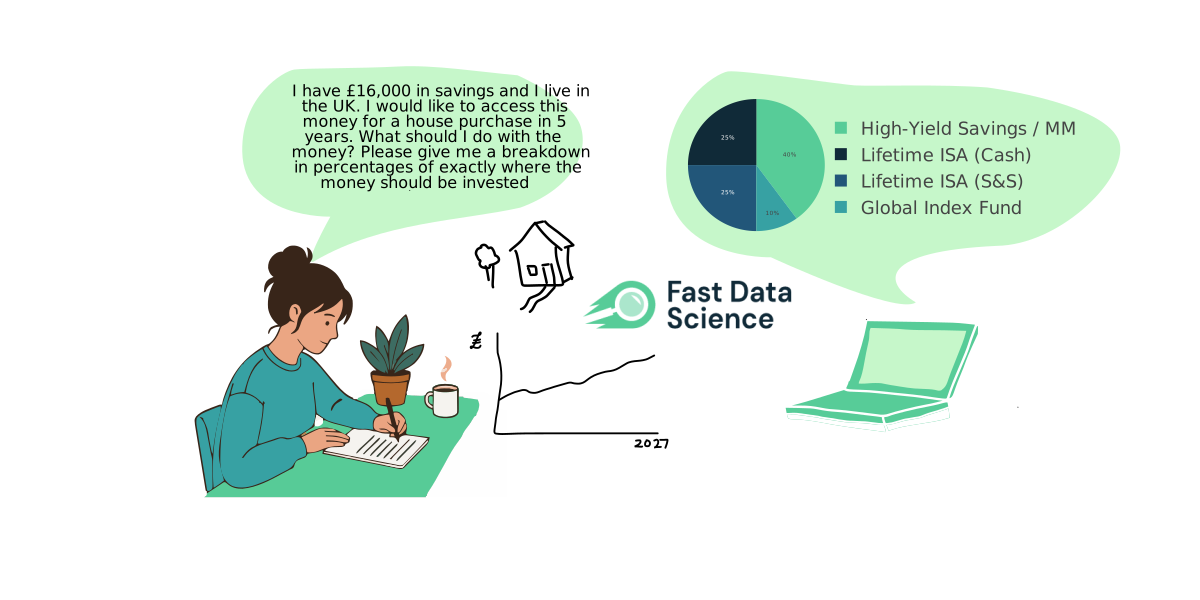
Financial advisors, like lawyers, are regulated in the UK. All financial advisors should be registered with the Financial Conduct Authority (FCA) and must have certain qualifications and have signed up to a code of ethics. UK financial advisors must also complete professional training every year.
What we can do for you