If you are developing an application that needs to interpret free-text medical notes, you might be interested in getting the best possible performance by using OpenAI, Gemini, Claude, or another large language model. But to do that, you would need to send sensitive data, such as personal healthcare data, into the third party LLM. Is this allowed?
Fortunately, it is possible to use LLMs for sensitive data. You just need to ensure a few boxes are checked.
Generally, you are not safe to paste sensitive data into the browser version of a large language model such as GPT. You would not have the guarantee that the company running the LLM will not store your data or use it for training.
However, if you set up a deployment of the relevant model, you can use it and be sure that the data is safe.
The Health Insurance Portability and Accountability Act, or HIPAA, is the main healthcare privacy law that you will need to be aware of if you are processing data in the US. HIPAA is a U.S. federal law designed to keep protected health information (PHI) from being disclosed without the patient’s consent or knowledge. HIPAA ensures that doctors, hospitals, and insurance companies keep patient data safe, while also giving patients the right to see their own records.
HIPAA applies to “Covered Entities” (doctors, insurers) and their “Business Associates” (billing companies, IT) within the U.S. healthcare system. If you are developing a healthcare application for the US market, you will be likely considered a Business Associate and need to sign a Business Associate Agreement (BAA).
If you are processing personal data of people living in the UK or EU, you will need to be aware of your obligations under GDPR, the General Data Protection Regulation. While HIPAA and GDPR both aim to protect sensitive information, they are built on fundamentally different philosophies. HIPAA is a specialised law for the American healthcare industry, while GDPR is a broad “human rights” law for all personal data in the EU.
GDPR applies to any organisation anywhere in the world that processes the personal data of people living in the EU or UK. If a Londoner uses a U.S.-based app, that app must follow GDPR.
One way in which GDPR is stricter than HIPAA is in the “right to be forgotten”. If a user requests their data be deleted, you are responsible for removing that data from any storage and ensuring its permanent deletion.
To use OpenAI and remain HIPAA compliant, one of the simplest approaches is to use OpenAI via a Microsoft Azure account. At present, using the OpenAI API provided directly by OpenAI rather than via Microsoft Azure is not HIPAA compliant. There are also separate products such as ChatGPT for Healthcare which offer HIPAA compliance.
You need to have an organisational account with Microsoft Azure, and you can create a deployment of OpenAI in your Azure account. This deployment should be located in the USA. You can then connect up your application to the API endpoint within your Microsoft Azure account.
If you use Microsoft Azure, you will be covered by a Business Associate Agreement (BAA) between Microsoft and your organisation, which is an essential requirement of HIPAA compliance.
To ensure that your entire application is HIPAA compliant, you need to ensure that:
Amazon Web Services (AWS) offers a similar service called Amazon Bedrock, where you can build a HIPAA compliant application and be covered by a signed Business Associate Agreement (BAA) with AWS.
Another way of keeping on the right side of HIPAA is to use an on-premises or self hosted solution. Instead of using a closed source model like OpenAI, you can host your own version of an open-weights model like DeepSeek.
Since you are in control of all servers in this scenario, you only need to take the usual steps to ensure HIPAA compliance, such as no caching, secure connections, but you don’t need to worry about the aspects of compliance that are associated with an external provider like OpenAI.
The above Azure and AWS solutions can also be made to be GDPR compliant, but like HIPAA, you must fulfil certain responsibilities to remain GDPR compliant. AWS and Microsoft provide the secure infrastructure, but you are responsible for how you handle personal data within it.
Instead of a Business Associate Agreement, under GDPR, you must have a formal agreement with any “Data Processor” (like AWS). The AWS GDPR Data Processing Addendum is automatically included in the AWS Service Terms.
GDPR also often requires that data stays within the EU or a country with “adequate” protections, so you would need to deploy the large language model in the appropriate region such as the UK or Ireland.
| Feature | HIPAA Requirement | GDPR Requirement |
|---|---|---|
| Document which you need to sign with third parties who are processing the data (e.g. OpenAI, Microsoft, Amazon) | Business Associate Agreement (BAA) | Data Processing Addendum (DPA) |
| Primary goal of the legislation | Protect PHI (protected healthcare information). | Protect personal data including outside the domain of healthcare. |
| Location | Data processing takes place on U.S. soil. | The subject of the data is a UK/EU resident |
In addition to using the regular general-purpose large language models, the big tech companies have developed products for particular purposes. For example, if your goal is clinical documentation (like transcribing doctor-patient visits), AWS offers a specialized service called AWS HealthScribe, which is powered by Bedrock. It is specifically designed to be HIPAA-compliant for medical note generation.
Looking for experts in Natural Language Processing? Post your job openings with us and find your ideal candidate today!
Post a Job
Unlock your business potential with expert AI consulting services from Fast Data Science. Discover strategies to accelerate growth and outperform competitors.
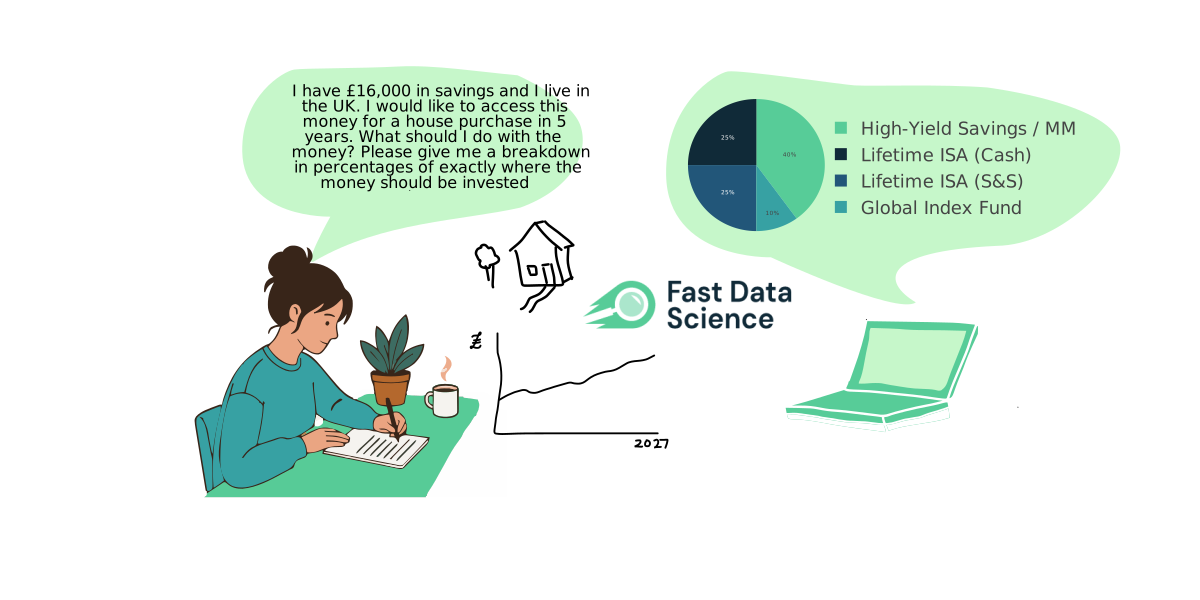
Financial advisors, like lawyers, are regulated in the UK. All financial advisors should be registered with the Financial Conduct Authority (FCA) and must have certain qualifications and have signed up to a code of ethics. UK financial advisors must also complete professional training every year.
What we can do for you