When AI companies train models on text, video and images from creative industries, the end product is an AI model which can create near-human quality visual designs or copywriting. Many artists have argued the AI companies are exploiting creatives by profiting from their work, while the original creators do not receive any compensation. By flooding the market with low-cost content, AI has driven down rates for human artists, which is threatening creative careers.
Artists are also distressed by style mimicry, where AI models can create instant artworks “in the style of” Banksy, Van Gogh, Frida Kahlo, or Tracy Emin.
In the recent Getty Images v Stability AI case, a judge ruled that Stability AI’s image generation model, which was trained on images belonging to Getty Images, didn’t infringe Getty Images’ copyright because an AI model doesn’t store the original photos and is not a copy in the sense of copyright law. It was also difficult for Getty Images to enforce their copyright because Stability’s training took place outside the UK - meaning that jurisdiction appears to only apply to the location that the model training took place in. The Getty ruling revealed gaps in copyright law that the UK government is now trying to fix.
The UK government has proposed changing copyright rules to make it easier for AI companies to mine content, by assuming that creative works are fair game for training AI models, unless the creators choose to “opt out” of such arrangements. In other words, all your artwork can be used to train an AI unless you take proactive steps to prevent it.
TV companies and film makers have claimed that this opt-out system is unworkable. Eric Fellner, co-chair of Working Title Films, called the proposal an “existential threat” to creative industries.
In February 2025, over 1000 musicians including Kate Bush, Annie Lennox, and Damon Albarn released a silent protest album titled Is This What We Want?, which had 12 silent tracks had titles that collectively spelled out: “The British Government Must Not Legalise Music Theft To Benefit AI Companies.”
In the last week, British artists were granted a small victory, as the House of Lords released a landmark report titled AI, Copyright and the Creative Industries[1], which criticised all of the government’s opt-in models. (For readers outside the UK, you might be surprised to learn that in 2026, unlike in other countries, we still have an upper chamber partly composed of people who have inherited their special position and right to vote on Acts of Parliament from their ancestors.) However, the Lords’ report has been criticised as “kicking [copyright] down the road” in the Financial Times.[2]
The House of Lords recommended that the UK government abandons the “opt-out” models for creatives, introduce protections against “in the style of” AI outputs, and force companies to be transparent about where their training data came from. In other words, the UK should move towards a more regulated approach to AI training.
The Lords also recommended the UK should build its own sovereign AI using licensed data.
We heard that one of the most acute harms arising from generative AI outputs is outputs ‘in the style of’ an artist. These can imitate their recognisable style, voice or personality in a way that displaces commissions or devalues the distinctive appeal of their work without reproducing a substantial part of any particular work.
Unfortunately, I don’t think the House of Lords’ recommendations will have any effect at all.
AI training and model use can take place anywhere in the world, so whatever the UK does to enforce certain restrictions will be easily bypassed.
I don’t see how AI can be prevented from creating works “in the style of” an artist. It is currently legal for a human to manually create an artwork in the style of an artist, and I struggle to see an effective way that we can forbid AI models from doing this without granting artists a monopoly over a particular creative style, which ultimately harms other artists. If “painting like David Hockney” becomes a legal infringement, it could lead to a wave of frivolous lawsuits against human artists.
UK based AI companies have argued that under the government’s proposals or the proposals in the Lords’ report, it will be hard to compete with US and Chinese companies, who operate under more permissive rules, and the UK would miss out on the AI boost to the economy. The idea of a sovereign AI has been criticised as unrealistic. It would be hard for the UK to train a publicly-owned “clean” model which would be able to compete with GPT-5 or Gemini.
I do not foresee any large changes coming quickly off the back of the Lords’ report, and even with the best of intentions, any legislative measures can be bypassed by tech companies using more permissive jurisdictions for training their models.
Ready to take the next step in your NLP journey? Connect with top employers seeking talent in natural language processing. Discover your dream job!
Find Your Dream Job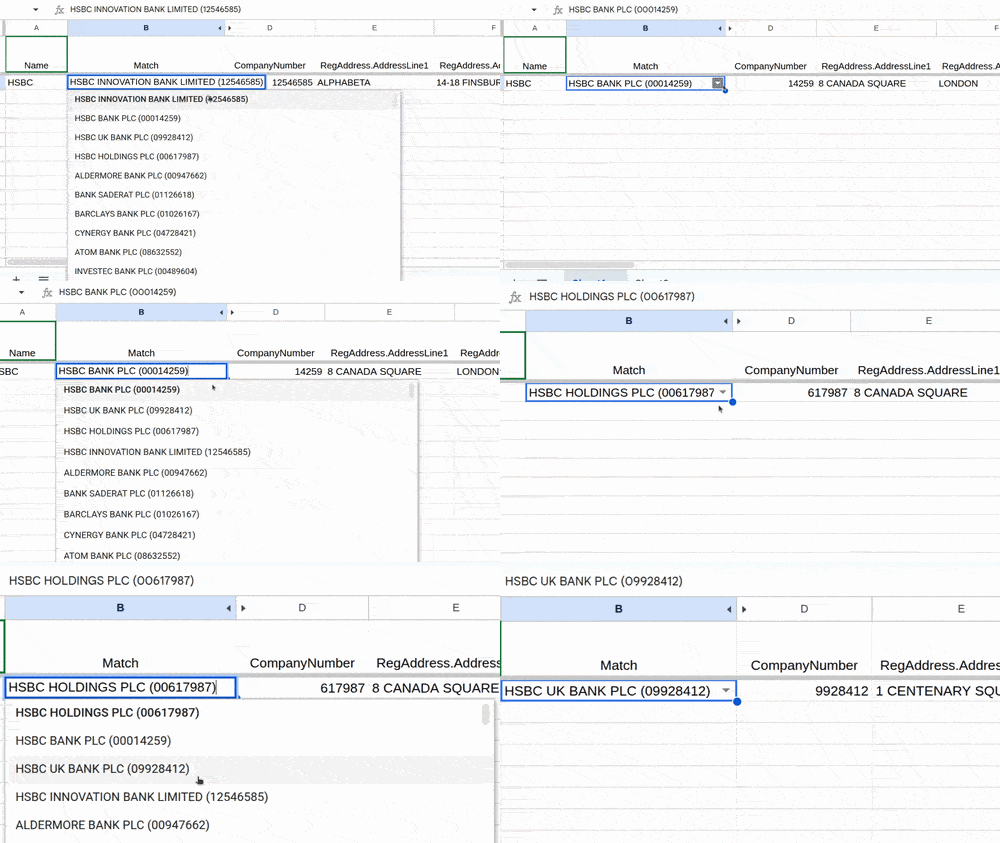
Fast Data Science are pleased to announce we have updated the UK Company Details Google Sheets™ plugin. The plugin allows you to retrieve details such as company number, incorporation date, address, and directors’ details from Companies House (the UK company registry) and automatically populate them in columns of a Google Sheets™ spreadsheet.
We are all familiar with the general-purpose chatbots like Gemini, GPT, and Claude. Companies and organisations have also been creating internal and external facing special-purpose chatbots, such as those which can book flights, tell you the weather, answer healthcare related queries, or answer questions about government procedures.
What we can do for you