This is an article based on my presentation on “The Role of Artificial Intelligence in Expert Investigations and the Preparation of reports” which I gave at the Expert Witness Conference on 20 May 2026.
Instructing lawyers and expert witnesses are increasingly concerned about the advent of AI and how this affects the content of expert reports. This concern is generally about large language models (LLMs), but we are also hearing more and more about other kinds of AI, such as image and audio and video generation. Large language models, such as ChatGPT, Gemini and Claude, are next word prediction models. Like a 2000s Nokia phone which could predict the next word “home” if you type “I’m going”, large language models are simply a way of predicting the next word in a text, but they have a much larger context window (the number of words that they look back through), often going up to 10,000 words (as opposed to the two or three word look-up used in an old flip-phone).
In England and Wales, expert witness reports are governed by Civil Procedure Rules Part 35 (CPR 35) and Practice Direction 35 (PD 35), which lay the ground rules for what should be in a report. There is a requirement for a statement of truth:
I confirm that I have made clear which facts and matters referred to in this report are within my own knowledge and which are not. Those that are within my own knowledge I confirm to be true. The opinions I have matters to which they refer.
In Ireland, the closest equivalent to CPR 35 and PD 35 would be Order 39 Rules of the Superior Courts which covers duty to the court and avoiding bias.
At present (May 2026), neither CPR 35 / PD 35 nor Order 39 (nor the closest equivalents in the United States) have been updated to reflect the possibility of an expert using AI to write a report. In practice, expert witnesses often delegate parts of the report writing or investigation to subordinates, but the expert has ultimate responsibility for the content of the report. I would imagine the same rule to apply to any use of generative AI: whether or not the expert used AI in the drafting of a report, the expert still retains responsibility.
The following guidance has come out around AI in court proceedings, which I will refer to in this article.
UK: Artificial Intelligence (AI) Guidance for Judicial Office Holders, 31 October 2025. https://www.judiciary.uk/wp-content/uploads/2025/10/Artificial-Intelligence-AI-Guidance-for-Judicial-Office-Holders-2.pdf
Canada: The Use of Artificial Intelligence in Court Proceedings, 7 May 2024. https://www.fct-cf.ca/Content/assets/pdf/base/FC-Updated-AI-Notice-EN.pdf
UK: Bar Council: Considerations when using ChatGPT and generative artificial intelligence software based on large language models. 30 January 2024. https://www.barcouncilethics.co.uk/wp-content/uploads/2024/01/Considerations-when-using-ChatGPT-and-Generative-AI-Software-based-on-large-language-models-January-2024.pdf
UK: Civil Justice Council: Use of AI for Preparing Court Documents: Interim Report and Consultation, 14 April 2026. https://www.judiciary.uk/wp-content/uploads/2026/03/Interim-Report-and-Consultation-Use-of-AI-for-Preparing-Court-Docume.pdf
Large language models are prone to hallucinations. They can give responses which are patently untrue or contain fabricated facts. In the legal domain, LLMs have been seen to cite realistic looking but non-existent case law.
There is also the problem of semantic leakage. If I give an LLM a list of symptoms like She presented at the emergency room complaining of a high temperature, headache, being sick, and aches and pains and then add Her favourite colour is yellow, then the LLM can switch to a diagnosis of “jaundice” because of the mention of “yellow” - not even the most unqualified human would make this mistake.
A large amount of the training data in LLMs is US specific, so you get content which is noticeably the wrong jurisdiction. This is particularly noticeable for those of us in the UK and Ireland. In Reddan v An Bord Pleanála HC 2025, the applicant used the term “subordination to perjury” which is not a phrase recognised in Irish jurisprudence and clearly originated from another jurisdiction (Scotland or the USA).
Large language models are trained on huge text corpora (collections of text) and the statistics in them reflect the patterns and biases in the original training data.
For example, the sentence “He works at the hospital as a” and the sentence “She works at the hospital as a” yield very different completions in GPT 3.5:
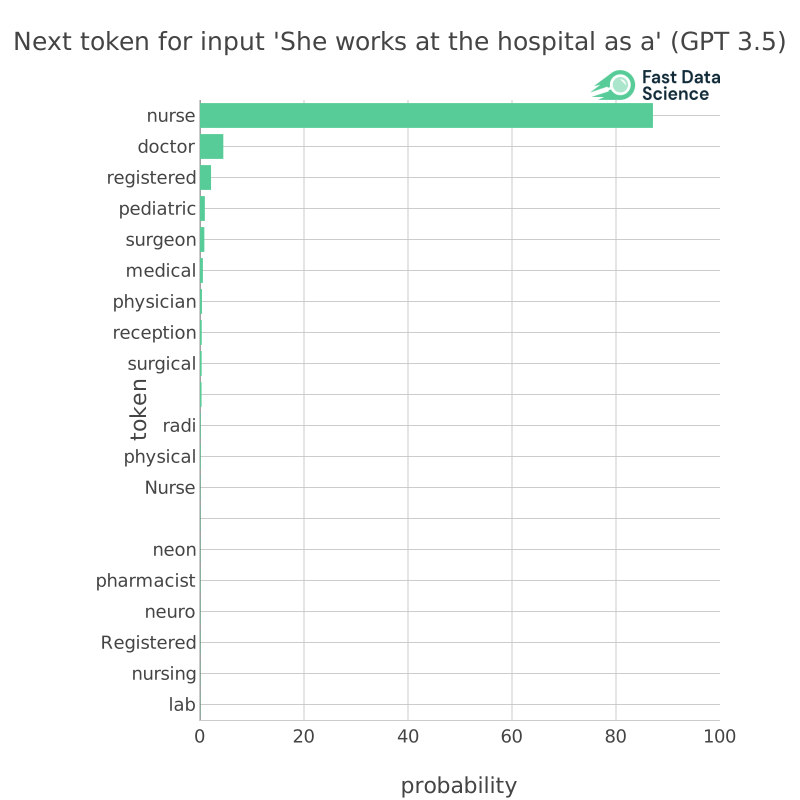
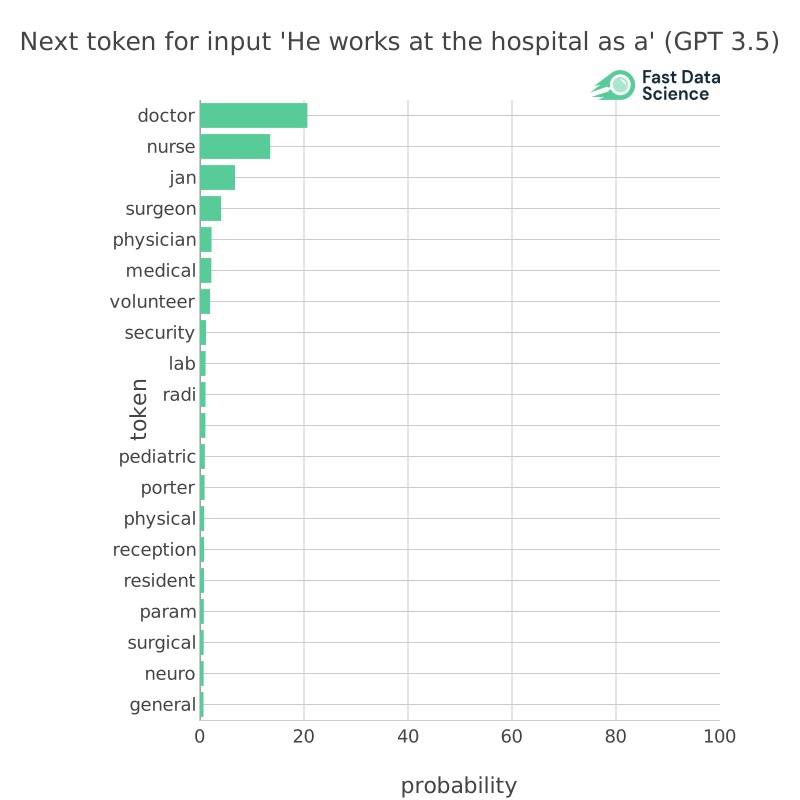
This has been corrected in later versions of GPT, but we ultimately don’t know what hidden biases may be inside the current models.
A large language model like ChatGPT is a third party service. It may also be hosted on a server in North America. So if you send confidential information in a prompt to ChatGPT in your browser,
Fortunately, many commercial versions of these platforms do offer confidentiality. The ChatGPT API needs programming skills to use, but does guarantee that data will not be retained.
In the UK, judges have been encouraged to use ChatGPT 365. A paid subscription like this usually guarantees that data will not be retained, but you should always check if the way you are using it complies with GDPR, HIPAA or other applicable rules.
If you would not post it on the internet, be careful about sending it to a chatbot.
It can be hard to reproduce your working with an AI model. Models are frequently deprecated (a tech company may cease offering that model as a service). If you do use AI for anything in an epert witness report, you should ensure that you have recorded all prompts used, as well as the version of LLM that was used to generate the outputs.
You should also be aware that an LLM takes into account the context of previous prompts, unless you have started a new conversation.
Content generated by LLMs may violate intellectual property rights. See Getty Images v Stability AI (2025), where Getty Images alleged that Stability AI’s generated images violated their trademark rights. Generative AI models are trained on large amounts of data scraped from the internet, and at present many tech companies are taking images and text from the internet which may be copyrighted and where the creators or copyright holders have not given permission for the content to be used to train a model.
The UK Bar Council’s guidance (above) also highlights the “Black Box syndrome”: the lack of explainability in AI models. We don’t know their internal workings.
OpenAI’s models are closed source and closed weights, while some other models such as DeepSeek are open weights (you can download and run them on your own computer) but it’s still very difficult to explain their workings. For example, if an AI model gives a series of tax calculations, it can be hard to reproduce all its logic and follow the working.
There have been a number of cases in the UK, Ireland and the USA, where lawyers, expert witnesses, or litigants in person have used generative AI to prepare submissions to the court.
In England, in R (Ayinde) v Haringey, one party made submissions to the Court containing hallucinated citations. The Court reduced the costs awarded to the plaintiff due to the wasted time from fake citations.
In Ireland, in Reddan v An Bord Pleanála HC 2025, the judge noted that submissions to the Court referred to legal concepts that don’t exist in Ireland and appeared to be Americanisms.
Back in England in the Construction and Technology Court, Justice Waksman found that a solicitor who insisted on an AI-generated expert report breached their duty to the Court.
In New York state, an expert in fiduciary services used Microsoft’s Copilot to cross-check calculations he used in expert evidence. He was unable to recall the prompts he used, state the sources Copilot relied on, or explain how the tool worked and arrived at its outputs.
The judge in the case said:
This brings to mind the old adage, “garbage in, garbage out”. Clearly a user of Copilot and other artificial intelligence software must be trained or have knowledge of the appropriate inputs to ensure the most accurate results.
Overall, submitting AI slop to a Court, whether as a lawyer, expert, or litigant in person, can result in wasted time, financial cost, reputational damage, and evidence being deemed inadmissible.
Around the world, courts and legal systems are introducing requirements for AI use to be declared and sometimes described in detail in court submissions and expert witness reports.
In the UK, the Civil Justice Council has produced a report titled, Use of AI for Preparing Court Documents: Interim Report and Consultation: https://www.judiciary.uk/wp-content/uploads/2026/03/Interim-Report-and-Consultation-Use-of-AI-for-Preparing-Court-Docume.pdf
In this consultation, the Council proposes a modification to PD 35 requiring declaration of AI.
We propose a requirement that the expert explains what use of AI has been made other than for transcription (or other administrative uses) and that the expert identifies the AI tools used.
In the United States, there is a proposed modification to the Federal Rules of Evidence (Rule 707), to clarify that AI evidence must be subject to the same standards as expert evidence.
In Ireland, the Court of Appeal has recently issued five guiding principles for the use of AI, in Guerin v O’Doherty [2005] IECA 48.
A lot of the new official and unofficial guidance from around the world is beginning to make the distinction between low and high risk use cases of AI. The judicial guidance from the UK distinguishes administrative tasks such as transcription from other higher risk tasks.
Below you can see a breakdown of what I would judge to be low, medium, and high risk uses of AI in the context of an expert witness investigation or report.
| Low risk | Medium risk | High risk |
|---|---|---|
| Machine translation | Expert builds and uses their own AI model (could also be high or low risk depending on use case) | AI writes a section of the report |
| Online research | Expert models scenarios with GPT | |
| Spell check | AI performs data analysis | |
| Transcription |
There is also a very helpful guide by the Academy of Experts where use cases have been presented on a scale from low to high risk, which I would recommend reading.
From the latest UK Judicial Guidance, we can conclude that experts must:
I have found a number of unofficial sources of advice on AI for expert witnesses. A law firm, Kennedys, has provided an article titled AI - the expectations for expert witnesses, with these takeaways:
You can read more here: https://www.kennedyslaw.com/en/thought-leadership/article/2025/ai-the-expectations-for-expert-witnesses/
Given all the limitations which I have listed above, you could be forgiven for asking if there is any circumstance at all in which AI would be appropriate for use in an expert witness report.
I would recommend to ask, is AI really necessary for your purpose? Generative AI often doesn’t improve a text, but adds noise to it, making it unnecessarily verbose. An expert witness report should be concise and factual. It’s not creative writing.
If you use AI to write any section of your report, you now have the problem of checking the AI output - in effect, the AI has engendered an extra administrative task. So AI has created work for you! I would find it easier to ensure all facts are correct while I am writing a sentence, rather than generate the sentence with AI and then have to check it after it’s been generated. It’s very easy to miss an unexpected hallucination.
You will need approval from the instructing solicitor (and possibly the court) to use it. If you get approval from your instructing solicitor and later find out that somebody else objects to the use of AI, you will have to redo the report. So I would ask, is it really worth it?
These concerns notwithstanding, here are some scenarios where AI could be beneficial:
In certain circumstances, AI can be a very useful tool for carrying out an investigation or preparing a report.
I have provided this checklist to ensure that your use of AI is appropriate and compliant and won’t come back to cause problems later. If I have missed anything out, please let me know.
☑ You are using AI for an administrative task, such as spell check, translation, or summarisation, rather than analysis that requires your expertise. (Judicial Guidance[1])
☑ No sensitive data is being sent out of the jurisdiction.
☑ Data is not being stored by a third party company.
☑ You are complying with all relevant privacy laws e.g. GDPR, HIPAA.
☑ You have saved all prompts and responses as well as the model version (e.g. GPT 4o) so you can reproduce them if asked.
☑ You have written permission from the instructing solicitor, as well as the court if applicable.
☑ You have verified all AI output and checked for hallucinations, fictitious citations, references to legal concepts from US jurisdictions, etc.
UK: Artificial Intelligence (AI) Guidance for Judicial Office Holders, 31 October 2025. https://www.judiciary.uk/wp-content/uploads/2025/10/Artificial-Intelligence-AI-Guidance-for-Judicial-Office-Holders-2.pdf, retrieved 23 May 2026.
Canada: The Use of Artificial Intelligence in Court Proceedings, 7 May 2024. https://www.fct-cf.ca/Content/assets/pdf/base/FC-Updated-AI-Notice-EN.pdf, retrieved 23 May 2026.
UK: Bar Council: Considerations when using ChatGPT and generative artificial intelligence software based on large language models. 30 January 2024. https://www.barcouncilethics.co.uk/wp-content/uploads/2024/01/Considerations-when-using-ChatGPT-and-Generative-AI-Software-based-on-large-language-models-January-2024.pdf, retrieved 23 May 2026.
UK: Civil Justice Council, Use of AI for Preparing Court Documents: Interim Report and Consultation, 14 April 2026. https://www.judiciary.uk/wp-content/uploads/2026/03/Interim-Report-and-Consultation-Use-of-AI-for-Preparing-Court-Docume.pdf, retrieved 23 May 2026.
Guerin v O’Doherty [2005] IECA 48.
Academy of Experts, https://taecdn.b-cdn.net/wordpress/wp-content/uploads/2026/02/fs-26-01-AI.pdf, retrieved 23 May 2026.
Fay Waterfield, AI - the expectations for expert witnesses, Kennedys Law, retrieved 23 May 2026.
Dive into the world of Natural Language Processing! Explore cutting-edge NLP roles that match your skills and passions.
Explore NLP Jobs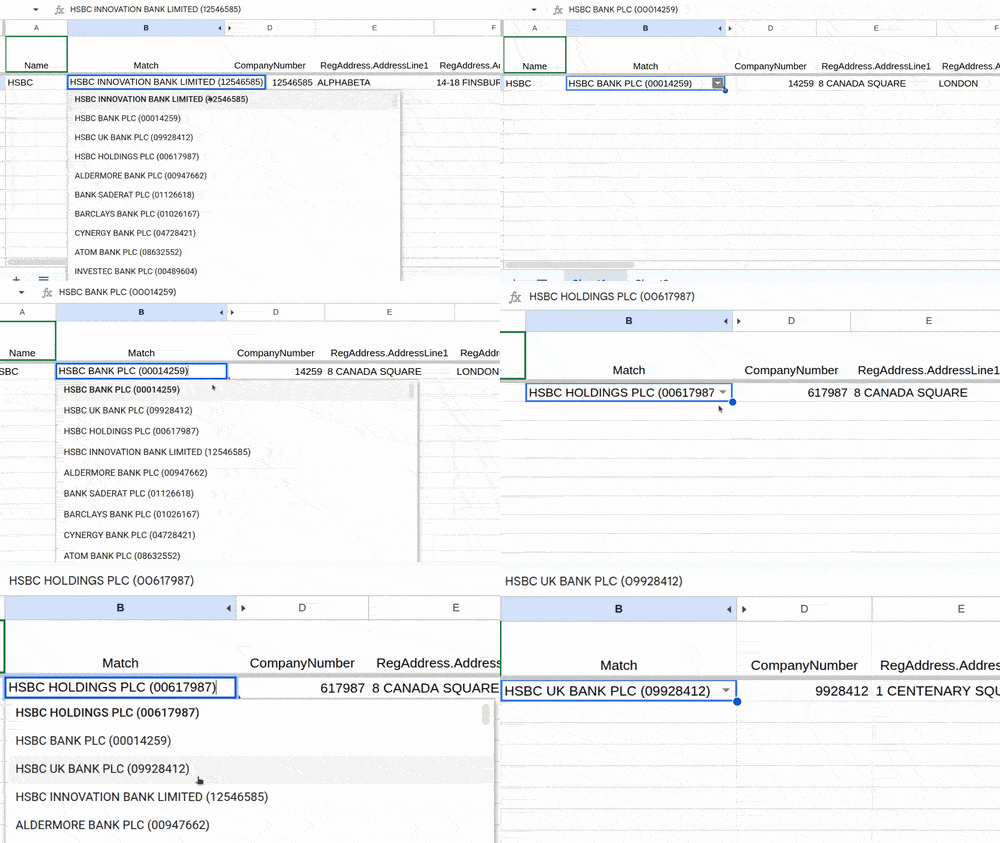
Fast Data Science are pleased to announce we have updated the UK Company Details Google Sheets™ plugin. The plugin allows you to retrieve details such as company number, incorporation date, address, and directors’ details from Companies House (the UK company registry) and automatically populate them in columns of a Google Sheets™ spreadsheet.
We are all familiar with the general-purpose chatbots like Gemini, GPT, and Claude. Companies and organisations have also been creating internal and external facing special-purpose chatbots, such as those which can book flights, tell you the weather, answer healthcare related queries, or answer questions about government procedures.
What we can do for you